
How poverty affects education is easiest to see in a child who wants to learn but arrives at school hungry, without a notebook or after spending the morning collecting water. The gap does not start with ability. It starts with what a household can and cannot afford, and it widens with every year a child falls behind.
This guide explains how poverty affects education at each stage, from the first years of life to the decision to leave school. It draws on U.S. research, UNICEF figures for Pakistan and what we see in Khano Goth, the Karachi community where Guardians Hands runs a school and a meal program.
How Poverty Affects Education Before a Child Starts School
Learning gaps appear early. A Stanford study of U.S. kindergarten data estimated that lower-income children were about six months behind in reading and seven months behind in math in 2010 compared with higher-income peers. The same report notes that differences by income do not change much as children move through the grades. A child who starts behind usually stays behind unless something changes.
Researcher Sean Reardon has linked the widening of this gap in earlier decades to wealthier parents spending more time and money on their children. Families under financial stress have less of both. Books, early learning materials and preschool cost money, and parents working long hours cannot always sit down with a child in the evening. None of this reflects how much a parent cares. It reflects a limit on income and time.
Hunger and Poor Health in the Classroom
Hunger is the most visible example of how poverty affects education. A hungry child has less energy to concentrate, and a child who is often sick misses weeks of lessons. Poor households face both problems at once. Meals are smaller and less varied, and medical care is harder to reach.
Unsafe drinking water adds to this. Repeated stomach infections mean repeated absences, and each absence makes the next lesson harder to follow. We cover the health side in our article on waterborne diseases and RO plant solutions.
The School Costs Families Do Not See on a Fee List
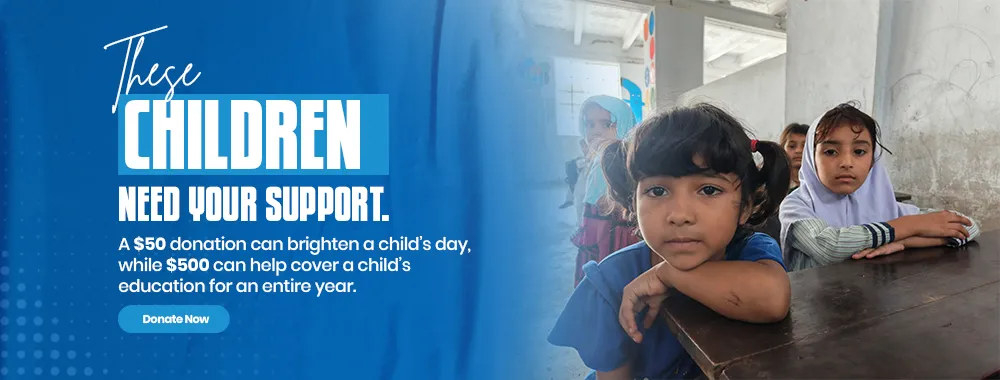
The cost side of how poverty affects education is easy to underestimate. Even where tuition is free or low, school has other costs. Uniforms, notebooks, stationery and transport add up, and a family choosing between supplies and dinner will usually choose dinner. At our school in Khano Goth, more than 100 students started a recent school year without basic essentials.
Child labor is the other side of the same problem. A child who can earn a little or look after younger siblings can seem more useful at home than in a classroom. When a family can afford to send only some children, girls are often the ones kept home, which is why girls’ education needs its own attention. Whether schooling should be free is a separate argument, and we make the case in why education should be free.
Time Poverty: When Water and Chores Fill the School Day
Time is the least discussed part of how poverty affects education, because poverty takes time as well as money. In communities without a reliable water supply, children are often the ones sent to fetch it, and that means missing class. In Khano Goth, water collection has kept children out of school, and our RO plant now supplies clean water to more than 1,500 people every day. Children who do not spend their mornings on water runs are in a better position to be in class on time.
How Poverty Affects Education in Pakistan
Here is how poverty affects education in Pakistan at national scale. The country has one of the largest out-of-school populations in the world. UNICEF estimates that 25.1 million children aged 5 to 16 are not attending school, which is about 35 per cent of that age group. In Sindh the figure is 7.4 million children, or 44 per cent of school-age children in the province.
Household income is one of several causes, alongside distance to school, the quality of teaching and social norms about girls. These factors feed each other. A family with little income is less likely to send a child to a distant or poorly staffed school, and a child who learns little is more likely to drop out and start earning.
What Helps Children Stay in School and Learn
Once you see how poverty affects education at the household level, the fixes become practical. The approaches that work tend to remove the specific barrier in front of a child. In our experience in Khano Goth, that means a few practical things.
- Meals at school. A child who eats at school can concentrate and families save a meal’s worth of cost. Our work on feeding vulnerable communities explains how the meal program fits in.
- Supplies and uniforms. Covering the small costs removes an easy reason to keep a child home.
- Clean water and basic health care. Fewer sick days and fewer hours spent on water runs mean more time in class.
- Steady support. Education is a multi-year effort, and a child needs the same conditions in year four as in year one. This is why we write about the power of monthly giving.
Frequently Asked Questions About Poverty and Education
Q1. How does poverty affect education?
Put simply, how poverty affects education comes down to hunger, poor health, the cost of supplies, child labor and the time children spend on chores such as collecting water. These pressures reduce attendance and make it harder to learn when a child is present.
Q2. How does poverty affect access to education?
Poverty limits access when families cannot cover uniforms, books or transport, or when a child’s work or care duties take priority over school. Distance to a school and a lack of nearby schools make this worse.
Q3. How does poverty affect girls’ education?
When money is short, families may choose to send boys to school and keep girls at home for household work. Girls’ education usually needs targeted support such as safe classrooms and community buy-in.
Q4. How does education reduce poverty?
Education raises the skills and earning options available to a child as an adult. Over time, an educated child is better placed to support a family and send the next generation to school, which breaks the cycle.
Q5. How does poverty affect education in America?
How poverty affects education in the United States shows up as a gap in early reading and math skills at kindergarten that tends to persist through later grades, as the Stanford research above shows. Food insecurity and unstable housing add to the challenge.
Q6. How can I help a child in poverty stay in school?
Support programs that remove the actual barriers, such as meals, supplies and clean water, and prefer organizations that report where the money goes.
Support a Child’s Education in Khano Goth
Guardians Hands is a U.S.-registered 501(c)(3) that funds a school, a meal program and an RO plant in Khano Goth, Karachi. Now that you know how poverty affects education in Khano Goth, you can donate for child education and help keep a child in the classroom.